Cybernetic Systems and Controls
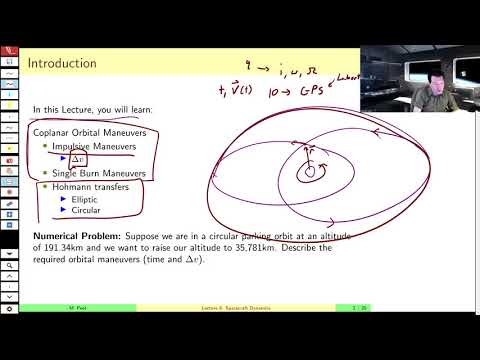
Delta-v is the change in velocity needed to move a spacecraft from one orbit to another, and it matters because a spacecraft cannot change its position directly — it can only change velocity, which then determines a new orbit. Since position at the moment of a burn cannot jump, but velocity can, a maneuver reshapes the orbit's other orbital elements (such as semi-major axis, eccentricity, or apoapsis and periapsis) while leaving the burn point's position essentially fixed; connecting two orbits that do not intersect requires an intermediate transfer orbit and one delta-v burn onto it plus another off of it. This belongs to orbital mechanics and astrodynamics, specifically the study of impulsive orbital maneuvers, and it underlies spacecraft navigation and trajectory design, the "path-planning problem" of getting from an initial orbit to a target orbit.