Dr Germán Rosas-Acosta
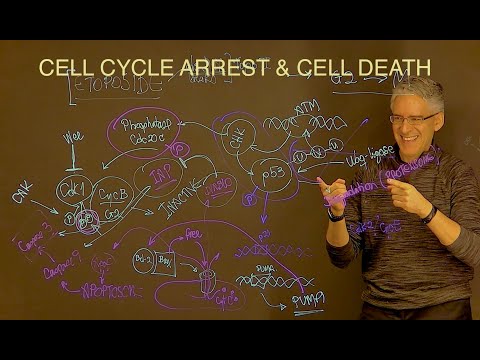
DNA double-strand breaks activate the ATM kinase, which phosphorylates checkpoint (Chk) kinases; active Chk kinases both inhibit the phosphatase Cdc25 (preventing removal of inhibitory phosphates from the Cdk1-cyclin B complex, thereby halting the G2-to-M transition) and stabilize p53 by blocking its ubiquitin-mediated degradation. Accumulated p53 acts as a transcription factor that, at sufficient levels, activates the pro-apoptotic gene PUMA, whose product displaces Bax from Bcl2 inhibition, allowing Bax to form mitochondrial pores that release cytochrome c and IAP-antagonizing proteins (e.g., DIABLO), triggering apoptosome formation and a caspase-9/caspase-3 cascade that executes apoptosis. This is a mechanism in cell biology/molecular biology linking DNA damage sensing, cell cycle checkpoint control, and the intrinsic (mitochondrial) apoptotic pathway.