YaleCourses
45 minutes
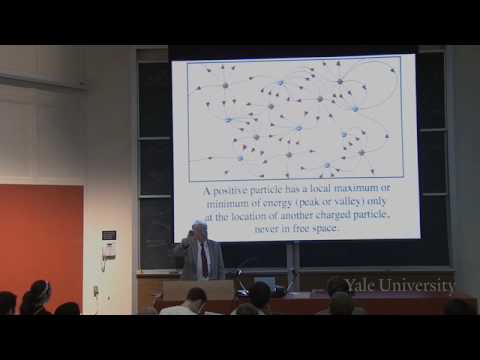
Earnshaw's theorem states that under pure inverse-square force laws (gravity, electrostatics, magnetism), no charge configuration can rest at a stable potential-energy minimum or maximum in free space — only saddle points are allowed — because such fields never converge to a point away from a charge itself. This underlies early atomic theory: Thomson's "plum-pudding" model (electrons embedded in a uniform positive sphere) satisfied the theorem by giving electrons a confining restoring force, and once replaced by a point-nucleus model, both Thomson and Lewis proposed that Coulomb's law must turn repulsive at atomic-scale distances to permit stability. The domain is physical chemistry / history of atomic theory, tied to Lewis resonance theory, where competing structures are judged by heuristic "lore" (minimizing charge separation, favoring octets) rather than rigorous law, and true structure (resonance vs. equilibrium) is settled experimentally.