Khan Academy
6 minutes
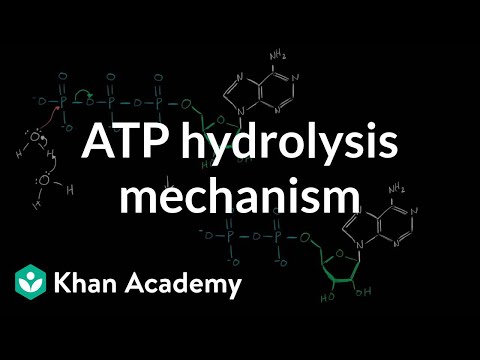
ATP hydrolysis is a nucleophilic substitution at the terminal phosphorus of adenosine triphosphate: water attacks the phosphorus, the terminal phosphoryl group leaves, and the products are ADP, inorganic phosphate, and a proton. Electron-pushing (curved-arrow) notation tracks lone pairs and bonding pairs to show how bonds form and break, and how formal charges shift. Energy is released because the crowded, mutually repelling negative charges of the triphosphate chain relax into a lower-energy, more stable electron arrangement, which is why ATP serves as the energy currency in biochemistry, within the bioenergetics branch of biochemistry and organic reaction mechanism theory.