Cybernetic Systems and Controls
43 minutes
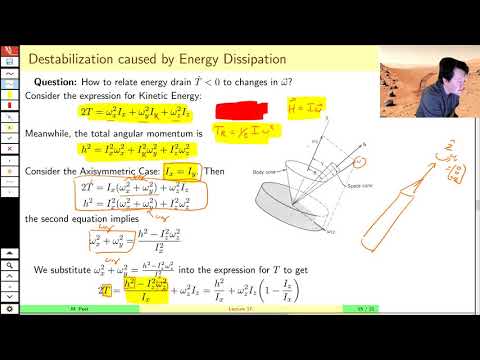
Energy dissipation makes a satellite spinning steadily about its minor axis slowly become unstable and start to tumble. Without any energy loss, spin about the major axis or the minor axis both look equally stable. But real spacecraft lose rotational kinetic energy over time, for example to sloshing fuel or flexing structure, while their angular momentum stays fixed. That energy loss makes minor-axis spin unstable, and the rotation slowly shifts toward the major axis, while spin about the major axis stays stable even as energy dissipates. This explains why satellites are built oblate (flatter shapes) instead of prolate (elongated shapes) like the rockets that launch them.