MIT OpenCourseWare
8 minutes
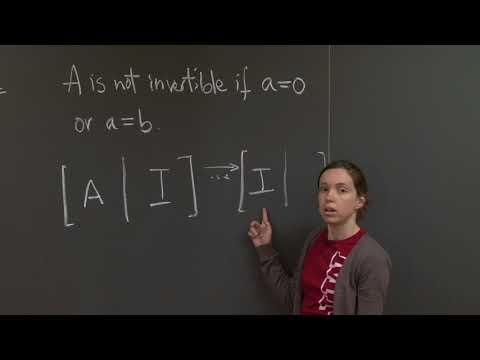
A square matrix is invertible if and only if it can be reduced, via Gauss-Jordan elimination applied to the augmented matrix [A | I], to the identity matrix on the left, at which point the right-hand side yields A⁻¹; matrices lacking this property (e.g., those with a zero row/column, or duplicate rows/columns) are singular. This is a core topic in linear algebra concerning matrix invertibility and inverse computation, connecting the qualitative notion of invertibility (nonsingularity) to the constructive algorithm of elimination, where any division by an expression that could equal zero identifies the algebraic conditions under which the matrix fails to be invertible. It relates to the broader theory of linear systems, since invertibility of a coefficient matrix determines whether a system has a unique solution.