MIT OpenCourseWare
48 minutes
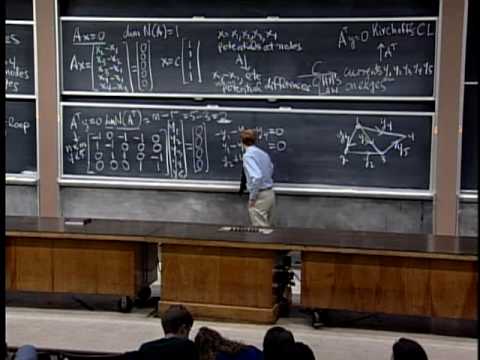
The core principle establishes that electrical network analysis is mathematically modeled using the incidence matrix to link node potentials and edge currents through Kirchhoff's laws within linear algebraic subspaces. The theory defines the null space of the transpose as circulation patterns satisfying current conservation (Kirchhoff's Current Law) via loop dependencies, while rank deficiencies in the column space reflect global potential indeterminacy up to an arbitrary constant grounded by boundary conditions. This framework integrates graph topology with physical circuit laws to solve equilibrium states without external dynamic forces, serving as a foundational structural model for applied mathematics and network science.