Cybernetic Systems and Controls
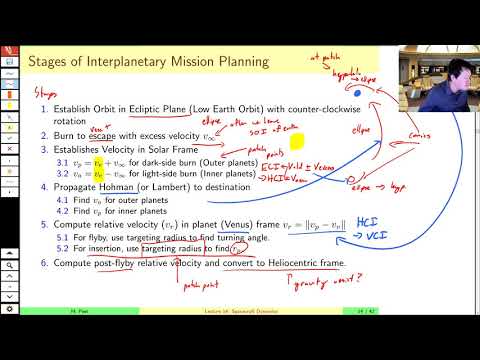
Interplanetary mission planning is the process of designing a spacecraft trajectory from one planet's orbit to another, and it is used to calculate how much velocity change a mission to a planet like Venus needs at each stage. It works by chaining together familiar two-body maneuvers — a plane change into the ecliptic, an escape burn out of the departure planet's sphere of influence, a Hohmann transfer through heliocentric space, and an arrival maneuver at the target planet — using the sphere-of-influence patched-conic model to link them. This concept belongs to orbital mechanics and astrodynamics, applying escape velocity, the Oberth effect, plane-change maneuvers, and Hohmann transfers already established for single-planet orbits to the multi-body interplanetary case.