MIT OpenCourseWare
47 minutes
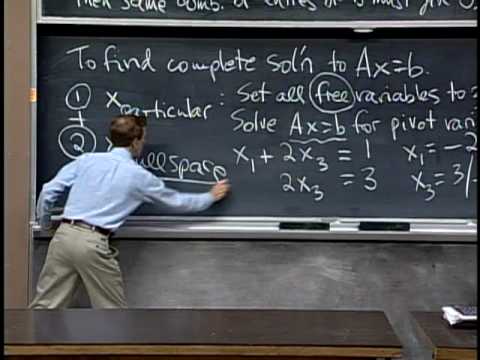
The core principle establishes that in a linear system $A\mathbf{x}=\mathbf{b}$ where $\mathbf{b} \neq \mathbf{0}$, the solution set forms an affine subspace defined as the translation of a homogeneous solution space by a particular vector. This concept relies on the distinction between homogeneous systems ($A\mathbf{x}=\mathbf{0}$), whose solutions constitute linear subspaces (lines or planes) passing through the origin due to closure under scalar multiplication, and inhomogeneous systems, which yield parallel affine spaces displaced from the origin by the particular solution. The theory demonstrates that within vector space geometry, the general solution is structurally decomposable into a constant particular component added to an arbitrary linear combination of homogeneous basis vectors.