Linear Independence of Basis Vectors in Euclidean Space
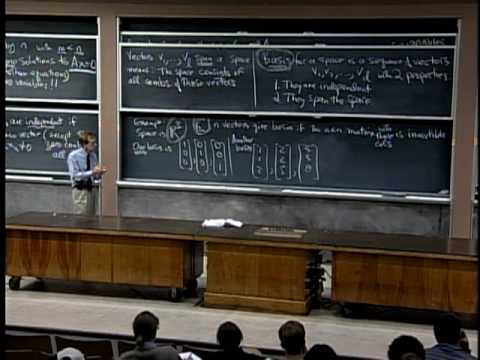
In Euclidean space $\mathbb{R}^n$, linear independence defines a condition where the only solution to a homogeneous system $c_1\vec{v}_1 + \dots + c_n\vec{v}_k = \vec{0}$ is the trivial solution ($c_i=0$ for all $i$). This property characterizes a set of vectors that forms part of or constitutes an ordered basis, ensuring no vector within the set can be expressed as a linear combination of others. The concept resides at the intersection of linear algebra and functional analysis, serving as the foundational criterion for determining dimensionality, span properties, and the invertibility associated with matrix representations in finite-dimensional normed spaces.
This Concept is waiting for its first lesson!
In Euclidean space $\mathbb{R}^n$, linear independence defines a condition where the only solution to a homogeneous system $c_1\vec{v}_1 + \dots + c_n\vec{v}_k = \vec{0}$ is the trivial solution ($c_i=0$ for all $i$). This property characterizes a set of vectors that forms part of or constitutes an ordered basis, ensuring no vector within the set can be expressed as a linear combination of others. The concept resides at the intersection of linear algebra and functional analysis, serving as the foundational criterion for determining dimensionality, span properties, and the invertibility associated with matrix representations in finite-dimensional normed spaces.
Are you a teacher? Sign in to start contributing.
Sign In