nptelhrd
54 minutes
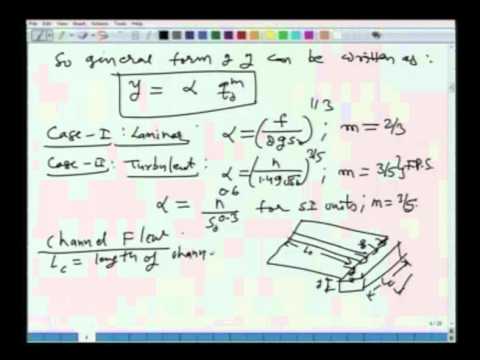
Overland flow modeling finds the depth and speed of a thin sheet of water running over the ground during rain, using a control volume (a fixed region we track flow through). Continuity (conservation of mass) gives the discharge per unit width: q0 = (i - f) x L0 x cos(theta), where i is rainfall, f is infiltration and L0 is the flow length. A momentum relation then gives the depth, with different forms for smooth (laminar) and fast (turbulent) flow. It is used to turn effective rainfall into the flow entering channels, and a Newton-Raphson iteration then finds the depth in a channel.