YaleCourses
50 minutes
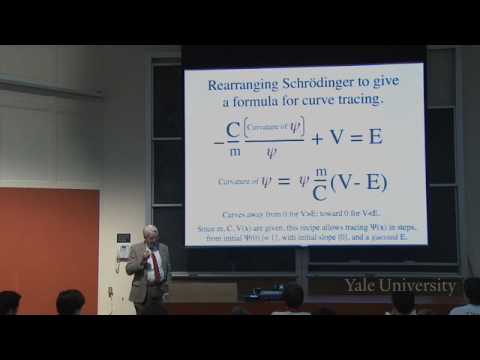
For a single particle in one dimension, the time-independent Schrödinger equation can be solved by shooting/numerical integration: given a trial total energy, the local curvature-to-amplitude relationship (kinetic energy = potential energy minus total energy, expressed via the wave function's second derivative) propagates the wave function point by point from an initial value and slope, and only energies for which the resulting function decays rather than diverging to infinity are physically allowed (quantized) solutions. This yields discrete eigenstates characterized by an integer number of nodes, with node count increasing monotonically with energy, and connects directly to Max Born's interpretation that the squared, normalized wave function gives a probability density rather than a deterministic trajectory. The concept belongs to quantum mechanics as applied to bound-state problems (e.g., vibrational motion in a chemical bond), linking wave function shape, energy quantization, and probabilistic interpretation.