YaleCourses
50 minutes
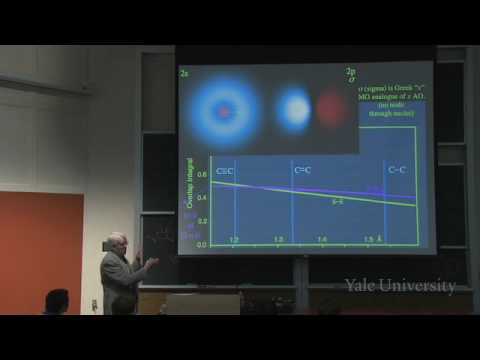
Bond strength between two atomic orbitals is governed by two independent factors: overlap (the value of the overlap integral, ∫a·b, which depends on internuclear distance, orbital symmetry type, and hybridization) and energy match (how close the two atoms' orbital energies are before combination). Symmetry rules dictate when overlap integrals vanish entirely (orthogonality between sigma- and pi-type orbitals) and how they scale with distance for various same-type combinations; hybridization enhances overlap by combining s and p character to bias density in a bonding direction. When energies are mismatched, the resulting bonding/antibonding energy splitting is reduced relative to the matched case, and the degree of mismatch controls which mode of bond-breaking (heterolysis versus homolysis) is favored. This is quantum/molecular-orbital theory within physical-organic chemistry, extending the overlap-based bonding picture with a second, independent determinant of bond strength.