YaleCourses
51 minutes
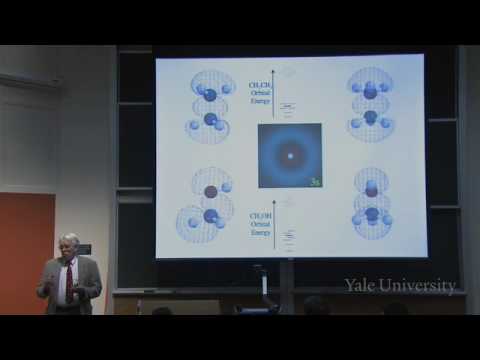
Molecular orbital (MO) theory of bonding constructs a pairwise molecular wave function as a linear combination of atomic orbitals (LCAO), ψ = (1/√2)(a ± b), on two different nuclei; squaring this sum produces not only each atom's own electron density but a cross term, a·b (the overlap density), that is significant only where the two atomic orbitals simultaneously have appreciable value. The symmetric (+) combination concentrates this overlap density between the nuclei, lowering kinetic energy and total energy (bonding), while the antisymmetric (−) combination depletes density between the nuclei and raises energy (antibonding); the overlap integral (the sum of a·b over space) quantifies the degree of orbital overlap and hence bond strength, and hybridizing atomic orbitals (mixing s and p character) or adjusting orbital exponents improves the overlap and the calculated bond energy toward the true (variational) minimum. This belongs to quantum/molecular orbital theory in physical-organic chemistry, providing the atom-pair (localized bond) complement to the whole-molecule "united atom" orbital picture.