YaleCourses
48 minutes
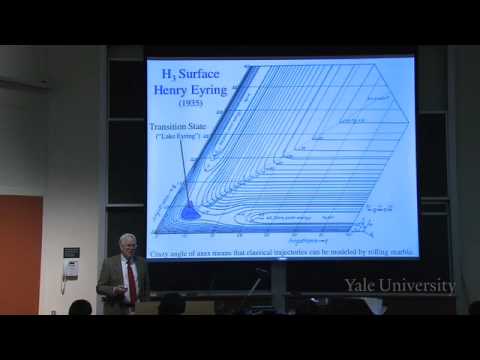
Equilibrium constants reflect a statistical combination of an energy (Boltzmann) factor and an entropy (counting) factor, where entropy measures the number of accessible structures or quantum states (e.g., a flexible conformer has more accessible states than a rigid one) and concentration effects (law of mass action) reflect the statistics of random particle encounters. Reaction rates, unlike equilibria, depend on the height of an activation barrier along a potential energy surface connecting reactant and product valleys through a transition state (the highest-energy point on the lowest-energy path, a saddle point); transition state theory approximates the rate as a universal frequency factor times the equilibrium concentration of species at the transition state. This constitutes physical organic chemistry's mechanistic framework: energies (via bond dissociation energies, not average bond energies) predict both feasibility (equilibrium) and rate (kinetics via barrier height and mechanism).