Cybernetic Systems and Controls
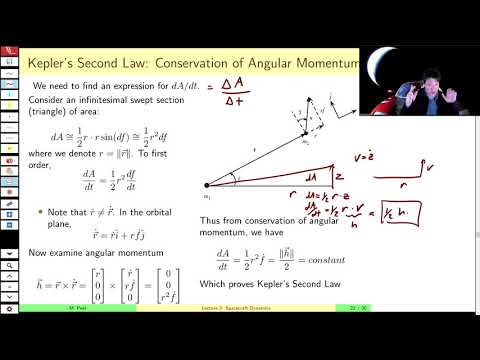
Kepler's second and third laws describe how a planet's speed and orbital period relate to its distance from the sun, and orbital mechanics uses them to predict where a satellite will be at any future time. The second law states that a line from the central body to an orbiting object sweeps out equal areas in equal time intervals, which can be proven directly from the constancy of angular momentum; the third law states that the square of the orbital period is proportional to the cube of the semi-major axis, derived by integrating the second law over one full period. A related quantity, the turning angle, describes how much a hyperbolic or parabolic trajectory bends between its incoming and outgoing directions and depends only on eccentricity.