Marginal Revolution University
3 minutes
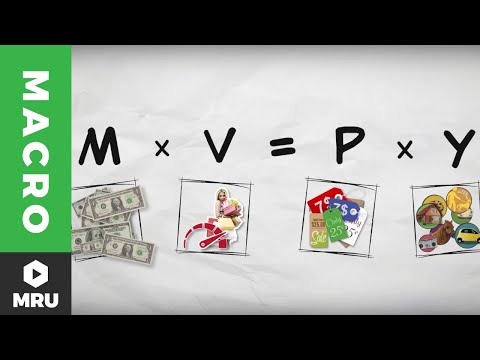
The Quantity Theory of Money establishes an accounting identity within macroeconomics stating that nominal GDP is equal to the money supply multiplied by its velocity ($M \times V = P \times Y$). In this framework, $M$ represents the total stock of money in circulation, $V$ denotes the frequency at which monetary units are spent on final goods and services, $P$ signifies the aggregate price level, and $Y$ measures real output. This relationship serves as a fundamental theoretical constraint used to analyze the determinants of inflation and nominal economic activity by linking financial variables with real production metrics.