Cybernetic Systems and Controls
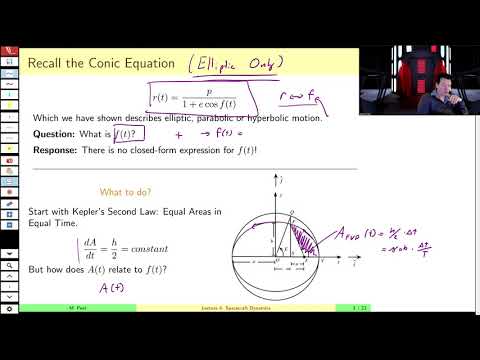
Kepler's equation relates time to an orbiting body's position by connecting three different ways of measuring angular progress around an elliptical orbit: mean anomaly, eccentric anomaly, and true anomaly. Because true anomaly is not a linear function of time, the conversion passes through mean anomaly (a direct, linear stand-in for time) and eccentric anomaly (a geometric angle defined using a circle inscribed around the ellipse), linked by Kepler's equation, which has no closed-form algebraic inverse. This method is used in orbital mechanics to predict a satellite's exact position at a future time, or to find when it will reach a given position, for elliptic orbits only.