Cybernetic Systems and Controls
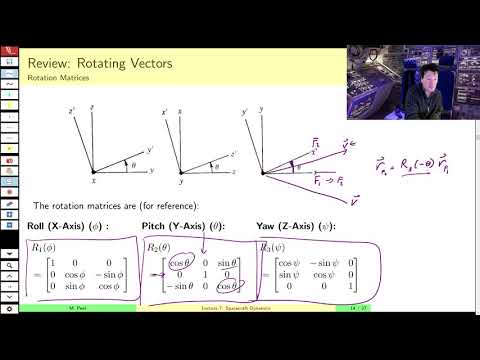
Rotation matrices convert a vector's coordinates between two Cartesian reference frames, and they let you express the same fixed position or velocity vector in a different coordinate system, such as converting a satellite's coordinates from an orbital frame to an Earth-centered frame. The three basic forms, called R1, R2, and R3, each rotate about a single axis (x, y, or z) using sine and cosine terms, and are combined in sequence to build up a full frame conversion. This belongs to orbital mechanics and rigid-body rotation theory: rotating a vector within a fixed frame uses a positive angle, while re-expressing that same fixed vector in a rotated frame requires the negative of that angle, and multi-step rotations must be multiplied in the reverse order in which the individual rotations occurred.