YaleCourses
50 minutes
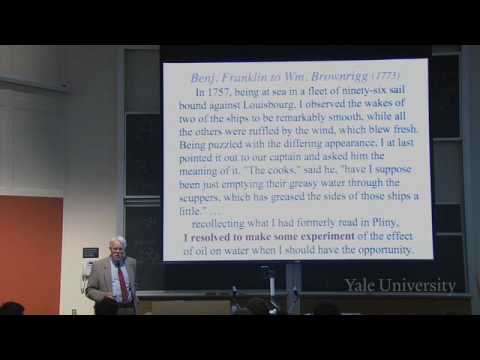
Scanning probe microscopy (atomic force, scanning tunneling, and scanning near-field optical microscopy) lets individual atoms and molecules be felt or imaged despite their tiny size, by detecting mechanical cantilever deflection, tunneling current between a fine tip and a conducting surface, or sub-wavelength optical emission through a nanoscale aperture — but none resolves the electron pairs (bonds) Lewis theory posits between atoms. This sits within the broader question of how molecular-scale entities, only about 10^5 times smaller than everyday objects (not "inconceivably" small), can be verified experimentally — historically done via indirect measurements (thin-film interference, monolayer spreading) that inferred molecular dimensions before direct-imaging instruments existed. The domain is physical chemistry / the history and methodology of measuring atomic- and molecular-scale structure, motivating but not resolving whether Lewis's shared and lone electron pairs are physically real.