Cybernetic Systems and Controls
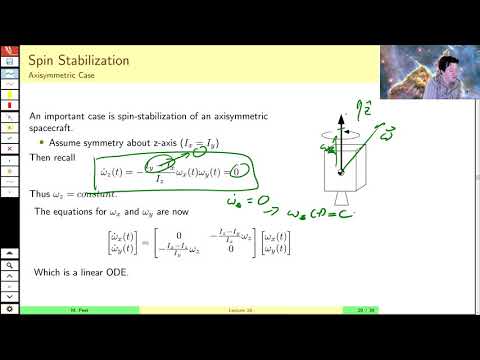
Spacecraft precession is the slow wobble of a satellite's spin axis when no outside torque acts on it. This concept explains why that wobble follows a smooth, predictable pattern instead of random tumbling. It applies to axisymmetric spacecraft, where two of the three principal moments of inertia are equal (Ix = Iy). These are analyzed using Euler's rotational equations of motion, a tool from spacecraft attitude dynamics. Under these conditions the spin rate about the symmetry axis, called omega_z, stays constant, so the angular velocity vector traces a cone around that axis at a fixed angle and rate called lambda. This lets engineers classify spacecraft shapes as oblate (flatter, mass far from the axis) or prolate (mass close to the axis), which sets the direction of precession and helps predict real wobble, like Earth's Chandler wobble.