Cybernetic Systems and Controls
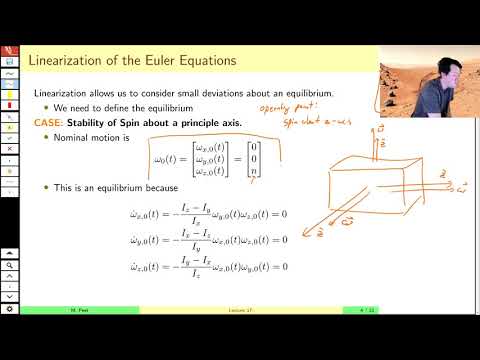
The intermediate axis theorem explains why an object spinning around its middle-sized axis suddenly flips end over end. It applies to a rigid body with three distinct principal moments of inertia, unlike the simpler axisymmetric case where two of them match. Linearizing Euler's equations of rotational motion around each axis shows that spin about the major axis (largest moment of inertia) or the minor axis (smallest) is neutrally stable, but spin about the intermediate axis is unstable, so small disturbances grow and flip the rotation. This explains real flips seen with tumbling wrenches, books, and satellites in free fall or orbit, and it is used in spacecraft attitude dynamics to know which spin axis is safe to use.