YaleCourses
49 minutes
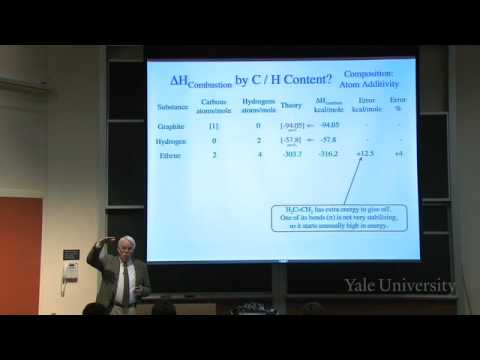
Molecular mechanics is a useful but not fundamentally correct model, since it assumes atoms interact as isotropic spheres — an assumption falsified by anisotropic (non-spherical) van der Waals contact distributions seen in crystal structures. Large statistical compilations of x-ray bond distances (e.g., the Cambridge Structural Database) show bond lengths are highly regular within finely subdivided structural categories (by hybridization and substitution pattern), varying systematically with hybridization, ring size, and substituent crowding. Bond-energy additivity — predicting a molecule's energy or heat of formation by summing standard bond or atom contributions — works only approximately: errors acceptable for physiological energy estimates translate into enormous (many-orders-of-magnitude) errors in predicted equilibrium constants, motivating a strain-energy framework referenced against measured heats of formation and heats of atomization.