Dr Germán Rosas-Acosta
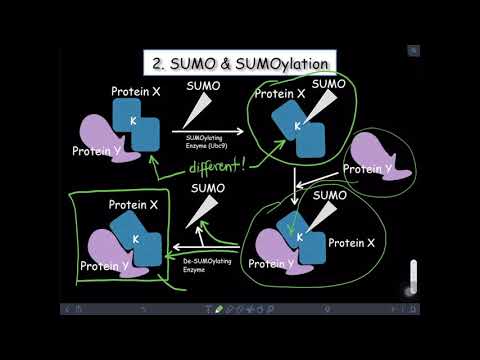
SUMOylation is a post-translational modification in which a small ubiquitin-like protein (SUMO) is covalently conjugated, via a three-enzyme cascade (E1 activating, E2 conjugating/UBC9, E3 ligase), to a lysine residue of a target protein, altering that protein's shape and thereby its profile of protein-protein interactions, stability, localization, or solubility, without necessarily marking it for degradation (in contrast to polyubiquitination, which targets proteins to the proteasome). SUMOylation is reversible and transient — SUMO proteases both process the SUMO precursor (exposing its diglycine motif) and deconjugate SUMO from substrates — yet its effects on protein conformation and interaction partners can persist after SUMO is removed. This body of theory belongs to molecular biochemistry/molecular cell biology, situating SUMOylation within the broader family of ubiquitin-like protein (UBL) post-translational modifications that regulate protein function and cellular processes.