YaleCourses
48 minutes
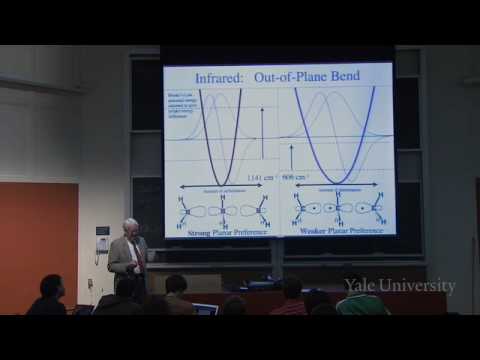
The Pauli-driven requirement that occupied atomic orbitals on one center not overlap fixes a quantitative relationship (via hybridization indices m, n) between the s:p mixing ratio of hybrid orbitals and the geometric angle between them, so that observed molecular geometry directly reflects hybridization. For a central atom forming three bonds plus zero, one, or two non-bonding valence electrons, optimal hybridization is set by a competition between maximizing bond overlap (favoring sp2, planar) and minimizing the energy of any non-bonding electron(s) by concentrating s-character there (favoring p-orbital bonds, pyramidal); the resolved geometry and its rigidity/flexibility follow from how this competition is weighted by electron count. This belongs to quantum-mechanical bonding theory in physical-organic chemistry, connecting orbital hybridization (an atomic-orbital-overlap and Pauli-exclusion consequence) to observable molecular structure, vibrational force constants, and spin density.