Cybernetic Systems and Controls
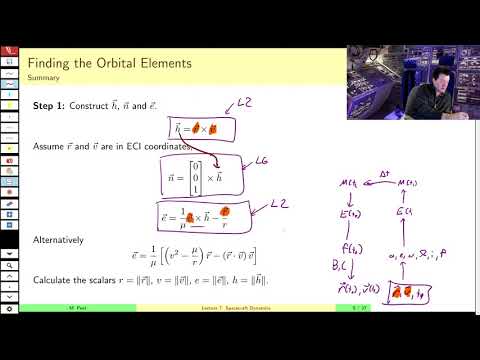
Orbit propagation is the process of predicting a satellite's future position from an earlier measurement, and it works by converting position and velocity vectors into orbital elements, advancing time, then converting back. From an initial position and velocity vector, the angular momentum vector, eccentricity vector, semi-major axis, inclination, right ascension of the ascending node, argument of periapsis, and true anomaly are calculated in sequence, each using an inverse-cosine formula paired with a quadrant check. To move forward in time, true anomaly is converted to eccentric anomaly and then mean anomaly, advanced by mean motion times the elapsed time, and converted back through eccentric anomaly to a new true anomaly using Kepler's equation, while the other five orbital elements stay fixed — this belongs to orbital mechanics and underlies satellite tracking and trajectory prediction.