Cybernetic Systems and Controls
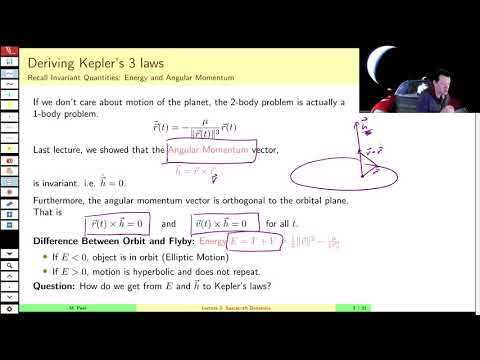
The eccentricity vector and the polar equation of orbital motion let you calculate the exact shape of an orbit from just one measurement of position and velocity. The eccentricity vector is a derived quantity that stays constant over time, points toward the orbit's closest point (periapsis), and has a magnitude equal to the orbit's eccentricity; combined with angular momentum, it produces the polar equation r = p / (1 + e·cos(f)), which gives orbital distance as a function of the true anomaly angle instead of time. This is used in orbital mechanics to prove that a body under gravity must move on a conic section (ellipse, parabola, or hyperbola) and to convert between physical quantities like energy and angular momentum and geometric orbit shape.