Cybernetic Systems and Controls
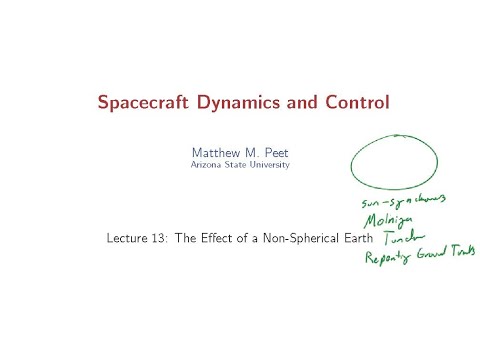
The J2 perturbation is the effect of Earth's equatorial bulge on a satellite's orbit, and it explains why a spacecraft's right ascension of ascending node and argument of periapsis drift steadily over time even without any thruster firing. It is the largest secular (non-canceling, ever-accumulating) perturbation to an orbit, arising because Earth's gravity field is not a perfect sphere but is decomposed into zonal, sectoral, and tesseral spherical-harmonic terms, with the zonal J2 term (coefficient about 0.00108, physically Earth's roughly 21 km equatorial bulge) dominating; converting the resulting disturbing force into radial-tangential-normal components and averaging over an orbit gives closed-form rates of change for right ascension and argument of periapsis that depend on inclination, eccentricity, and altitude. This is used to design orbits with deliberately controlled drift, such as sun-synchronous mapping orbits, repeating-ground-track communication orbits, and critically inclined orbits like the Molniya and Tundra orbits, and it belongs to orbital mechanics and astrodynamics as one of the two dominant perturbations (alongside atmospheric drag) to the idealized two-body orbit.