Cybernetic Systems and Controls
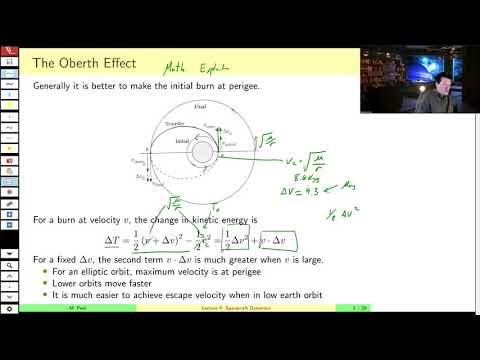
The Oberth effect explains why a rocket burn produces more extra kinetic energy when a spacecraft is moving fast (close to a planet) than when it is moving slowly (far away), and it is used to plan the most fuel-efficient point in an orbit to fire engines. Expanding the change in kinetic energy from a burn shows it equals one-half delta-v squared plus a cross term equal to the spacecraft's existing velocity times delta-v; at high initial velocity that cross term dominates, so the same delta-v yields far more energy gain there than at low velocity, and the reverse holds for energy-losing (negative delta-v) burns. This belongs to orbital mechanics and astrodynamics, and it is explained physically by rocket propulsion: propellant expelled near a planet, where potential energy is low, carries away less potential and kinetic energy than propellant expelled far away, leaving more energy with the spacecraft.