YaleCourses
49 minutes
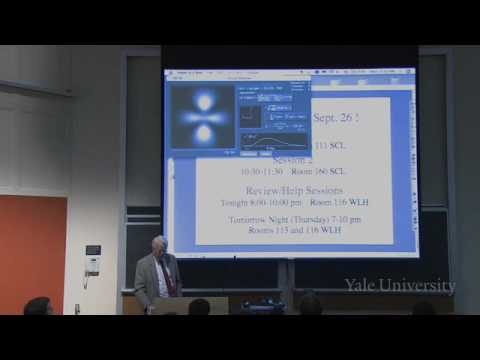
For hydrogen-like atoms (any nuclear charge, exactly one electron), the separated radial/angular solutions of the Schrödinger equation are exact, closed-form wave functions (orbitals), and their size, electron density, and energy scale predictably with nuclear charge Z and principal quantum number n. The orbital approximation extends this single-electron framework to multi-electron atoms by writing a many-electron wave function as a product of one-electron orbitals, which correctly reproduces additive energies and densities only if the electrons are statistically independent — but Coulomb repulsion between electrons makes them non-independent, so orbitals are, strictly, a convenient fiction beyond one-electron systems. The domain is quantum chemistry's treatment of atomic electronic structure, linking exact one-electron quantum mechanics to the approximation scheme underlying multi-electron atomic and molecular orbital theory.