YaleCourses
49 minutes
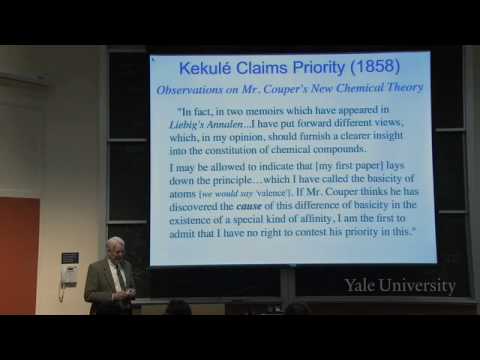
Valence theory (Couper 1858, Kekulé 1857-59) established that carbon is tetravalent and uniquely self-linking, so that molecular properties derive from the individual combining powers ("basicity"/valence) of constituent elements rather than from opaque "radical" or "type" units; this made explicit structural formulas possible, adding a third descriptive dimension — Constitution (the nature: single/double/triple, and sequence of bonds) — beyond mere elemental Composition (ratio of atoms). This concept belongs to structural organic chemistry and directly enabled the notational and conceptual distinction of isomers as compounds sharing composition but differing in bond connectivity, a distinction earlier composition-only theories (dualism, radical theory, type theory) could not express.