Dr. Trefor Bazett
8 minutes
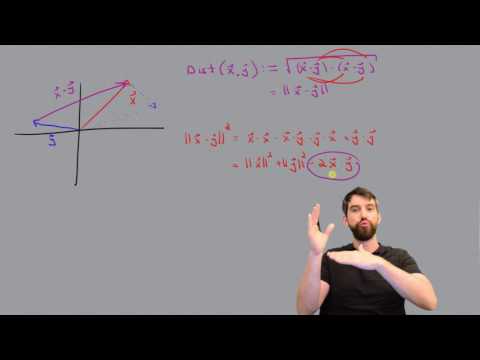
The core principle establishes that in Euclidean vector spaces ($\mathbb{R}^n$), distance and angle between vectors are defined via the inner product, which generalizes the Pythagorean theorem to $|u-v|^2 = |u|^2 + |v|^2 - 2(u \cdot v)$. This formulation defines orthogonality as a specific boundary condition where the dot product vanishes ($u \cdot v = 0$), reducing the law to a direct summation of squared norms. Consequently, this mechanism derives cosine similarity relationships allowing for the explicit calculation of angles via $\cos(\theta)$ and arc-cosine inversion within linear algebraic geometry.