MIT OpenCourseWare
50 minutes
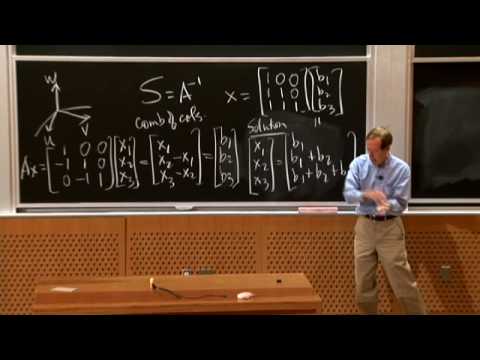
This is a foundational overview of linear algebra's conceptual progression from vectors to matrices to subspaces: linear combinations (scalar multiplication and addition) of vectors generate spans, which may be lines, planes, or the whole space depending on whether the vectors are linearly independent; a matrix formed by placing vectors in its columns encodes the linear combination operation, so that matrix-vector multiplication Ax produces a combination of the columns. The theory covers invertibility (a matrix has an inverse exactly when its columns are independent and form a basis, giving a unique solution to Ax=b), the relationship between differentiation/integration and matrix inverses as instances of inverse linear transforms, and the definition of vector spaces and subspaces as sets closed under linear combination, culminating in the idea that rectangular (non-invertible) matrices motivate the transpose operation and the symmetric matrix A^T A central to later topics like least squares.